A First-Day Welcome for a Shared Room
A first-day welcome for a shared room helps newcomers find the entrance, recognize where to wait, and reach the right host without guessing.
The common mistake in a first-day welcome for a shared room is beginning with a speech before a newcomer knows where to stand. The cost is an awkward pause at the doorway, often followed by a visitor interrupting an activity just to ask whether they have arrived at the right place.
A first visit needs a clear arrival route: where to enter, whether to wait or join, and whom to approach. Keep the broader explanation of the room’s purpose brief; the immediate task is helping someone cross the threshold without having to decode local habits.
Make arrival obvious
Start with the view from the entrance. A newcomer should be able to identify the room, spot the main activity, and see where to pause without walking through a group or opening a closed door.
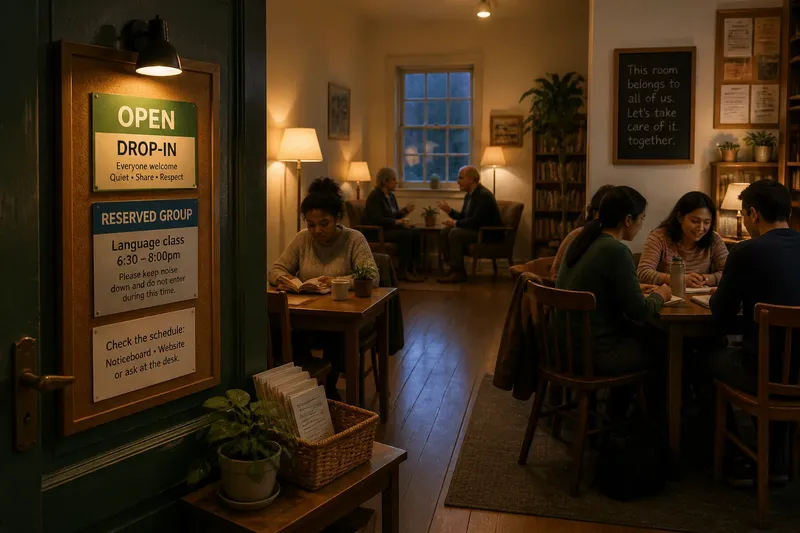
Use plain labels such as “meeting area,” “shared table,” or “please wait here.” Put a sign where it can be read before someone reaches the middle of the room. If a sign would obstruct a path or create confusion, place it beside the entrance instead.
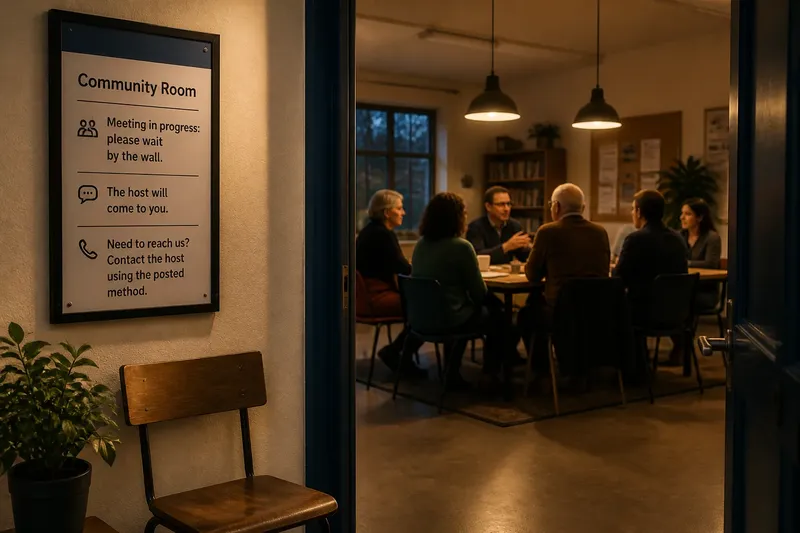
Say, “Imagine you arrive while a neighborhood meeting is already underway.” A sign beside the door reading “Meeting in progress: wait by the window; the host will come to you” gives the visitor a specific place to pause and avoids an interruption. If the window area is sometimes occupied, the sign should instead direct visitors to a visible contact point.
Offer a small greeting
A useful greeting is short and situational: “Welcome. The meeting is in progress; would you like to wait here or join quietly?” That gives the newcomer a choice without demanding an explanation of why they came.
When a host is available, they can add only what the visitor needs next: where to sit, whether the activity is open to newcomers, or when to return. Do not make a visitor listen to a tour before they have decided whether to stay.
If the room is quiet, a host can say where the shared seating is and point out any area that is not open for general use. A closed cabinet or marked work zone should remain off-limits unless the local arrangement says otherwise.
Keep signs useful
A first-visit sign is not a noticeboard in miniature. Include the room name, a short arrival instruction, and one reliable contact route; move schedules and longer explanations elsewhere if they make the entrance hard to read.
Use a role as well as a name when possible, such as “Ask the activity host.” If no host is present, give a backup route, such as a room coordinator’s posted contact method. Avoid listing several names without explaining who handles questions.
Check that the sign still matches the room. If chairs, waiting areas, or entrances change, update the wording or remove directions that no longer fit. A confident sign pointing to a missing chair is not much help.
How should arrivals work?
Where should a newcomer wait?
Choose a visible spot that does not block the entrance or interrupt an activity, then name it in a short sign or greeting. If no safe, unobtrusive waiting place exists, give a contact route before asking anyone to wait.
What if no host is present?
Post a clear backup contact method and state what a visitor can do in the meantime, such as wait in a designated area or return during a listed activity. If the contact details are not current, remove them until someone can verify the correct route.
Should a visitor join an activity?
Do not assume that a visible activity is open to newcomers. The host should say whether joining is welcome and, if so, where to sit or begin; if nobody can confirm, invite the visitor to wait or use the posted contact route.
How much should the host explain?
Cover the next useful action: wait, sit, join, or ask someone. Add detail only when the visitor asks or needs it to make that choice.
Check the arrival route
Review the entrance from a newcomer’s position rather than from the room’s usual seats. Use these observations to decide what to change:
- If the room name is not visible before entry, then move the sign beside the entrance; otherwise, keep its current position.
- If a visitor cannot tell where to wait, then mark a suitable visible spot or provide a contact route instead; otherwise, leave the waiting instruction as written.
- If the sign directs people through an occupied activity, then change the route to avoid crossing it; otherwise, retain the path.
- If the listed host or coordinator is unavailable or unclear, then replace the contact details with a verified route; otherwise, keep the named contact.
- If a visitor cannot tell whether an activity is open to newcomers, then add an instruction to ask the host or wait for confirmation; otherwise, leave the invitation clear.
- If a closed area looks like ordinary shared space, then label it or explain the limit at the entrance; otherwise, no extra boundary notice is needed.
Say you manage a room where visitors arrive during an evening meeting. The starting conditions are an entrance sign that names the room but gives no waiting instruction, a meeting table just inside the doorway, and a host who cannot leave the discussion. First, move the meeting table’s arrival route out of the sign’s path by directing visitors to a clear wall beside the entrance; next, add “Meeting in progress: wait by the wall and contact the host using the posted method.” Then confirm that the contact method is visible and current. The resulting choice is to keep the sign if visitors can wait without blocking entry and reach the host; if the wall is occupied or the contact route fails, change the instruction before relying on it.
Keep the welcome light
A first-day welcome for a shared room works best when the arrival instructions do their quiet job: show where to pause, offer a human contact, and make the next choice easy to understand. A brief greeting can then stay brief.
Revisit the entrance after changes to the room or its schedule. The practical question is simple: can someone arriving alone work out what to do before needing to interrupt anyone?